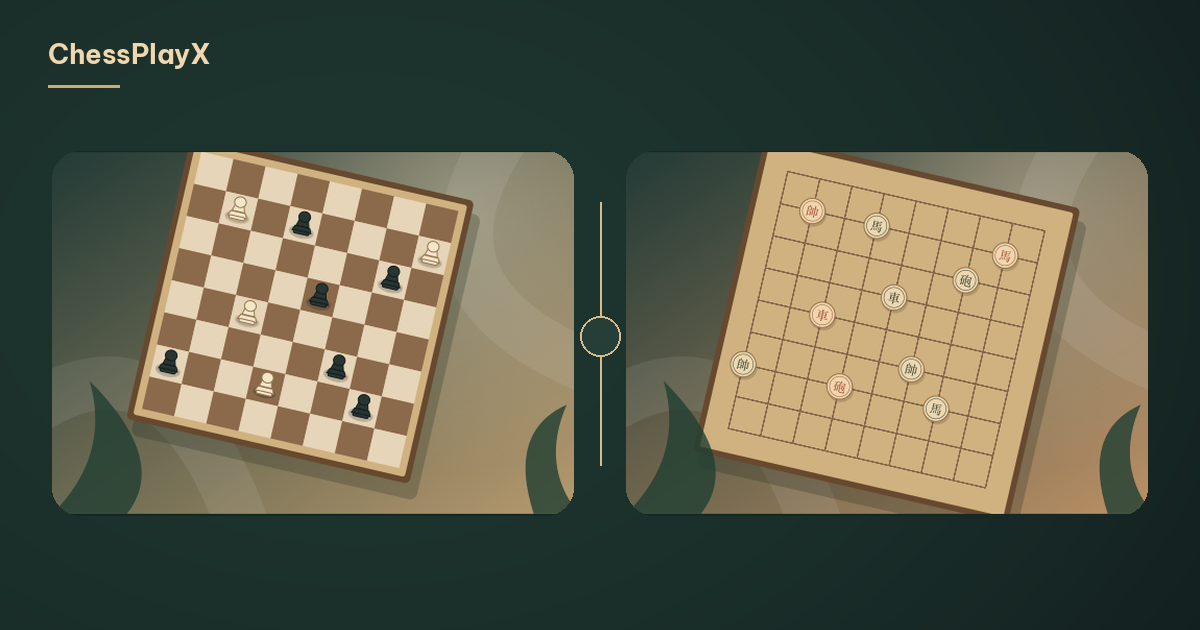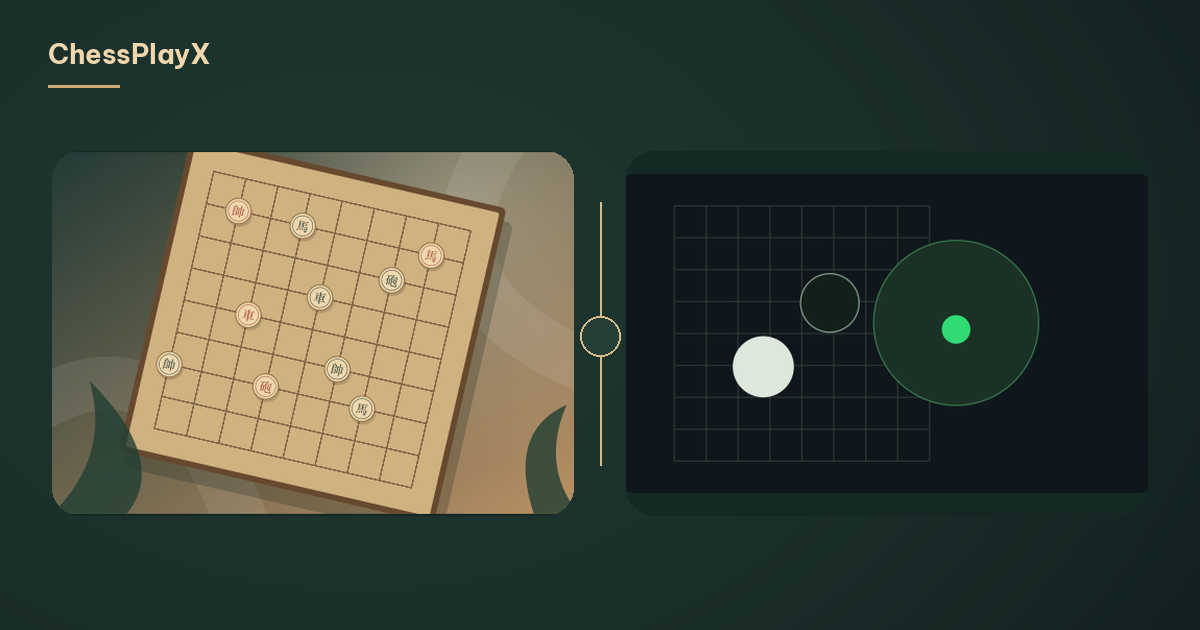
Xiangqi is built around attacking the opposing general; Go is built around the final score of territory or area. Xiangqi begins with different pieces in fixed positions. Go usually begins with an empty board, and players place stones that stay where they are until captured. Both demand tactics and strategy, but they ask you to evaluate a position differently.
Compare the two games
Scroll the table sideways to compare all columns.
| Feature | Xiangqi | Go |
|---|---|---|
| Standard board | 9 × 10 intersections | 19 × 19 intersections; 9 × 9 and 13 × 13 are common smaller boards |
| Starting position | 16 pieces per player in a fixed setup | Usually empty; handicap games are an exception |
| Playing pieces | Seven piece types with different movement rules | Black and white stones with the same placement rules |
| A turn | Move a piece already on the board | Place a stone on an empty intersection, or pass |
| Capturing | Move onto an enemy piece under the moving piece's rules | Remove an enemy group when it has no liberties |
| Main objective | Defeat the opposing general; inability to move also loses | Finish with the higher score under the agreed scoring rules |
| Repetition | Rules distinguish repeated checks, chases and other cycles | Ko or superko limits repetition, depending on the ruleset |
| Scoring | No territory score | Territory or area scoring, with komi where applicable |
What are liberties in Go?
A liberty is an empty intersection immediately next to a stone or connected group, horizontally or vertically. Diagonal contact is not a connection. Stones of the same colour connected along these lines share liberties. When a group loses its last liberty, it is captured and removed.
For example, a lone stone in the middle of an otherwise empty board has four liberties. A stone on an edge has three, and one in a corner has two. Nearby stones can change these counts. This makes connection, escape routes and the timing of captures central to a fight.
Why capturing is not the whole objective
In Xiangqi, winning material can help an attack, but the general's safety remains decisive. In Go, capturing a large group can be valuable, yet chasing every enemy stone may let the opponent build more profitable territory elsewhere. You must balance a local fight against the whole board.
Go's final score depends on the selected rules. Area scoring counts stones on the board and surrounded empty intersections; territory scoring uses territory and prisoners with its own procedures. Komi adjusts the score to compensate for playing second. Its value and the handling of dead stones must be checked before play.
Which should you learn first?
If you enjoy pieces with distinct abilities and direct attacks, Xiangqi may feel familiar. If you enjoy building shapes, connecting groups and judging space, try Go. These are preferences, not a ranking of intelligence or difficulty: both games combine short calculations with long-term plans.
A 9 × 9 Go board is a practical place to learn liberties and the end of a game. For Xiangqi, first learn the palace, the river, the horse's leg and the cannon's screen. Use the Xiangqi guide and the Go guide before testing yourself in a full game.
Frequently asked questions
Does Go have a king or general to capture?
No. Go stones have no royal piece. A game is normally settled by the agreed scoring rules or resignation, rather than checkmate.
Can Go stones move after being placed?
No. A placed stone stays on its intersection unless captured and removed. Your next turn places another stone or passes; it does not move an existing stone.
Are Go scoring rules identical everywhere?
No. Different rulesets use territory or area scoring and can differ in repetition, suicide and end-of-game procedures. Agree on the rules and komi before starting.
Sources and further reading
- World Xiangqi Federation: World Xiangqi Rules: Xiangqi movement and game results.
- British Go Association: the rules of Go: placement, liberties, captures and a first introduction to scoring.
- Read chess vs Xiangqi, then explore Xiangqi or Go on ChessPlayX.