News & guides
Product updates, a closer look at the games, and ideas for your next move.

Meet ChessPlayX: a home for board games
Discover ChessPlayX: play chess, Xiangqi and Go in your browser, learn the rules, invite friends and review your games. Choose the way you want to play.
Read article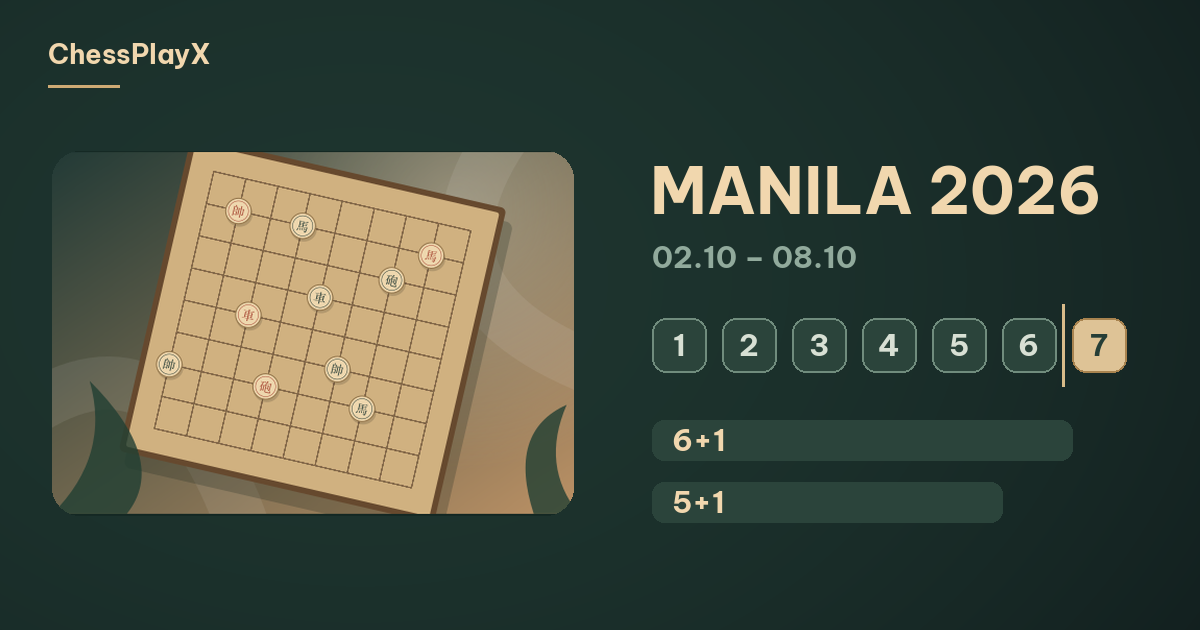 Tournaments
2026 Asian Xiangqi Individual Championship: schedule, format and players
Everything about the 2026 Asian Xiangqi Individual Championship in Manila: dates, round schedule, the 6+1 and 5+1 formats, time control, players to watch and world champion Lai Ly Huynh.
Read article- Game analysis
Asian Xiangqi 2026: learn to read the board through six games
Explore six games from Manila 2026. Step through key positions and learn how material, pawn structure and piece coordination shape a game.
Read article - Tournaments
Asian Xiangqi 2026: Feng Jiajun wins the men's title after a tiebreak-decided finale
October 6, 2026 in Manila: Feng Jiajun beat Wang Yubo in the men's final, and Tang Dan meets Hong Qianhui in the women's final. Lai Ly Huynh and Dam Thi Thuy Dung missed out on Buchholz.
Read article 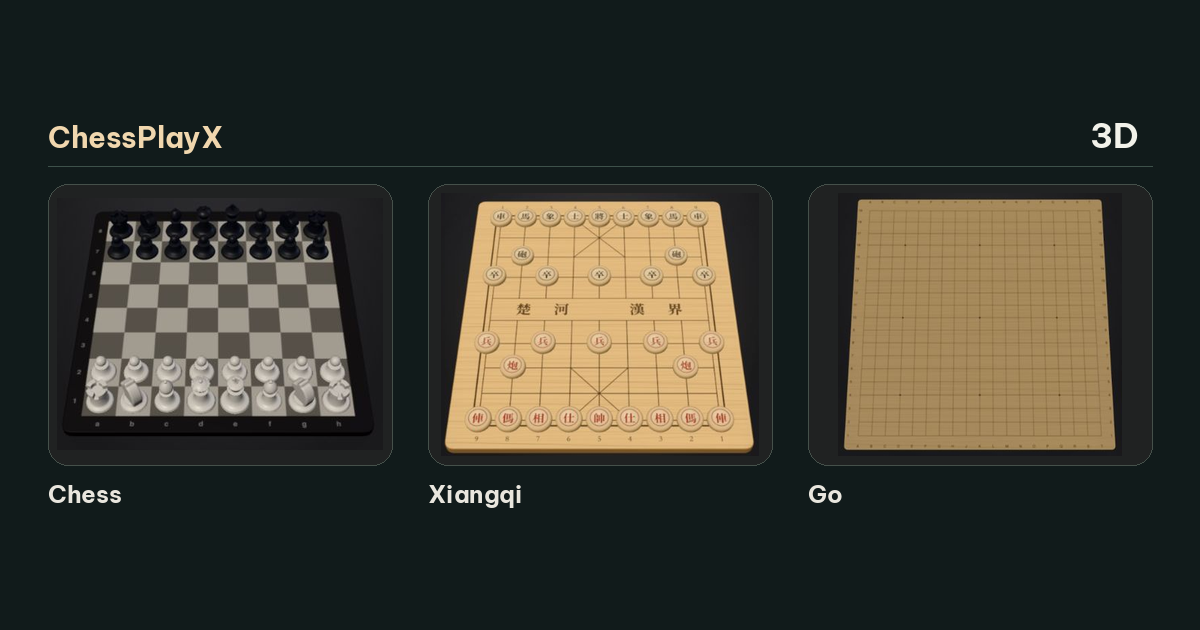 Product
3D Chess, Xiangqi and Go: how to play on ChessPlayX
Explore 3D Chess, Xiangqi and Go on ChessPlayX. Learn how to adjust the board, play AI or friends, switch to 2D and use your free 3D play allowance.
Read article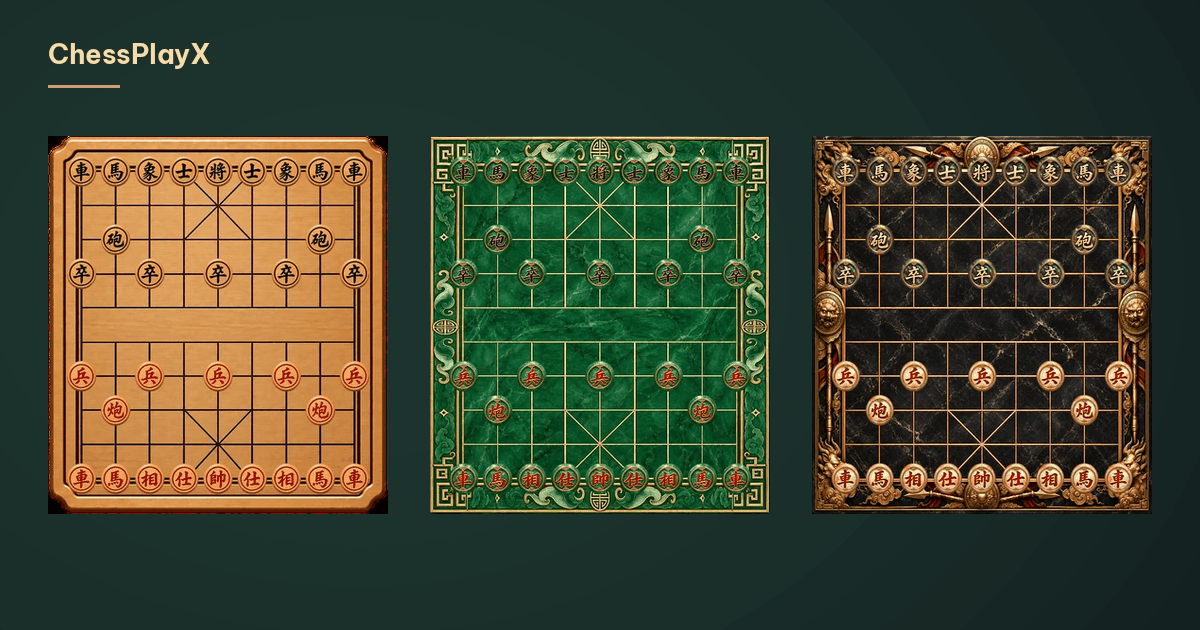 Player's corner
19 Xiangqi board and piece skins: find your style
Explore 19 Xiangqi board and piece sets on ChessPlayX, with real previews, steps to change your skin and tips for choosing a readable board on your phone.
Read article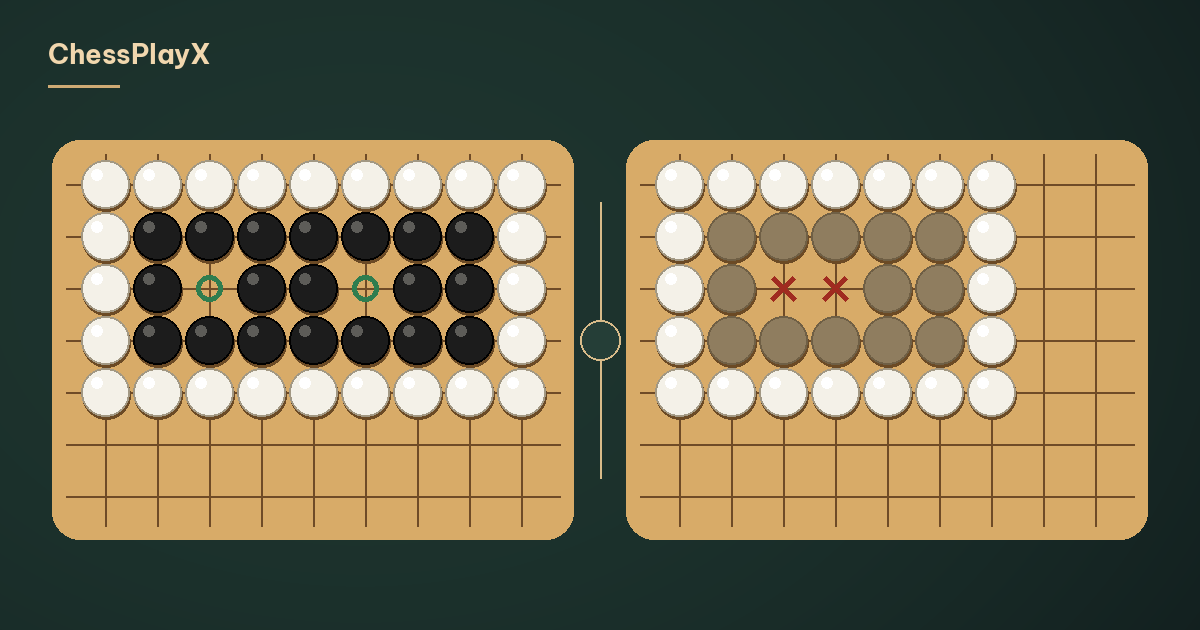 Strategy
What Is Tsumego? Reading Life and Death and Marking Dead Stones in Go
A practical guide to Go tsumego: real and false eyes, vital points, move order, ko, seki, and how to mark dead stones correctly at the end of an online game.
Read article Strategy
Jieqi strategy: reveal pieces, read the odds and play with a plan
A Jieqi (hidden Xiangqi) guide from rules to strategy: when to reveal, how to use fake chariots, cannons, advisors and elephants, and how to read the odds.
Read article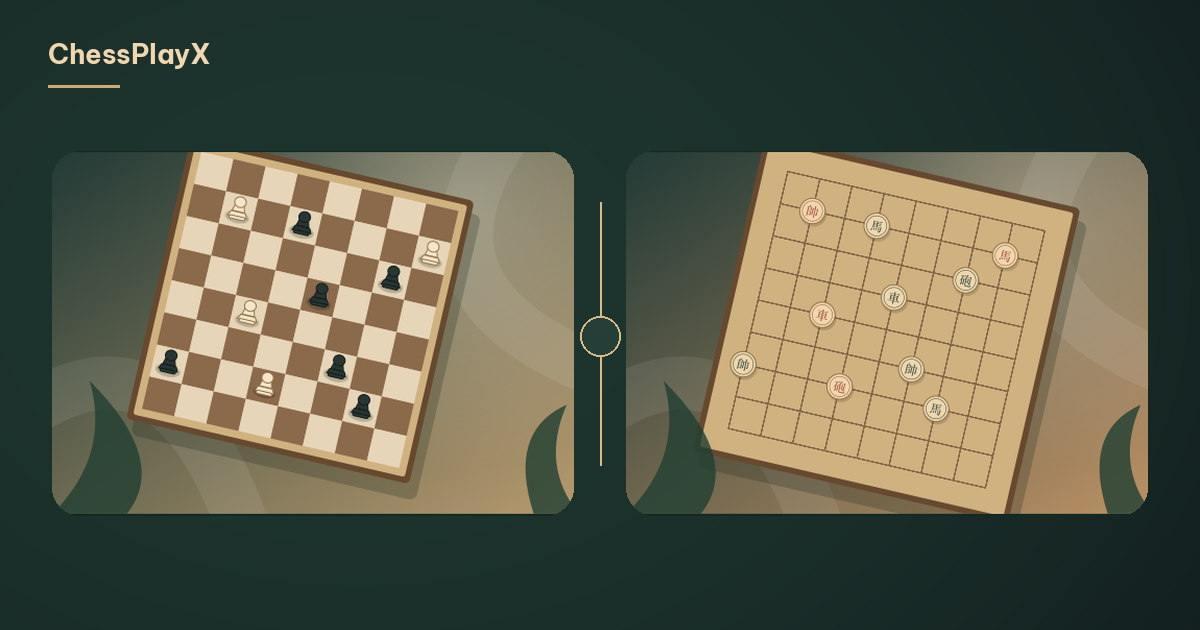 Comparisons
Chess vs Xiangqi: the key differences
Compare chess and Xiangqi: boards, pieces, cannons, blocked horses, promotion and stalemate. Learn what carries over and which rules you need to relearn.
Read article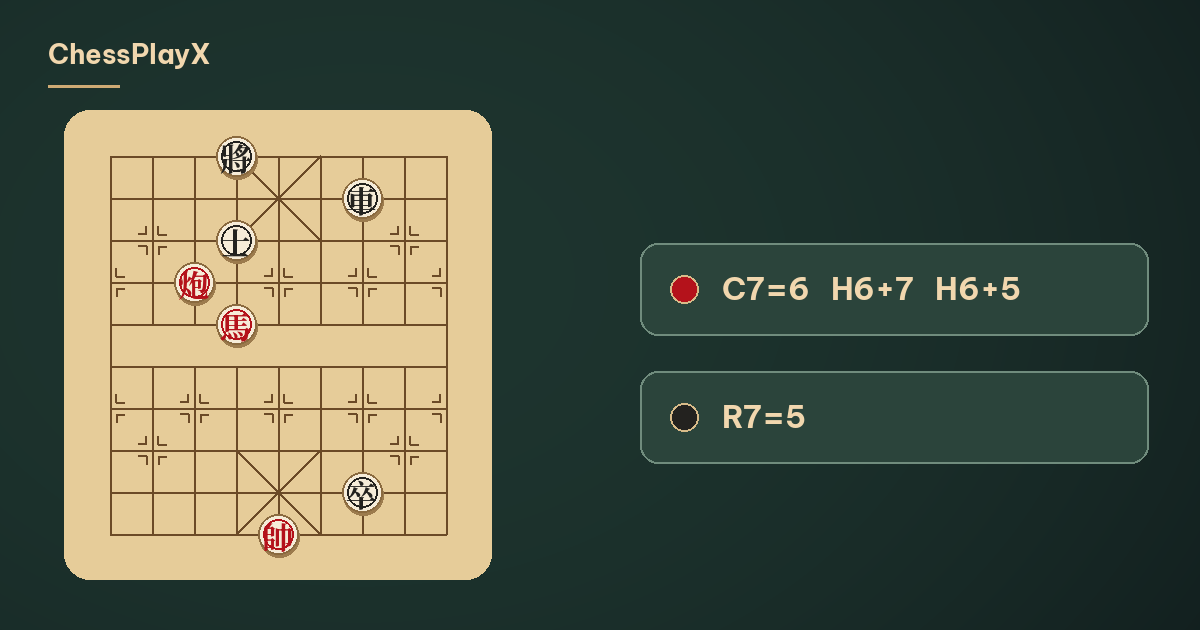 Strategy
Horse and cannon against a rook: the study where tempo decides
A sparse Xiangqi position analysed move by move. Red to move has exactly three checks, Black has one, and the ChessPlayX engine verifies every count.
Read article Comparisons
Xiangqi vs Go: checkmate, territory and strategy
How do Xiangqi and Go differ? Compare pieces, boards, captures, liberties, ko and scoring, then choose a practical way to learn your next board game.
Read article World Xiangqi Rules · 2018
Board, pieces and legal moves in Xiangqi
A Xiangqi board has nine files and ten ranks. Pieces stand on intersections. The river separates the two sides; the two palaces constrain Kings and Advisors. Red moves first. Each side starts with sixteen pieces of seven kinds (Articles 1–2).
Read article- World Xiangqi Rules · 2018
How a Xiangqi game ends: mate, stalemate and draws
A player with no legal move loses in Xiangqi, even when the King is not in check. Checkmate and stalemate are both losing outcomes under Article 3.1.A. Resignation, time and tournament infringements can also decide a game; draws have their own conditions.
Read article - World Xiangqi Rules · 2018
Reading and writing WXF Xiangqi notation
WXF Article 7 records a move with a piece identifier, its file, a direction and a destination or distance. The English symbols are K, A, E, H, R, C and P. Files are read from the moving player's side.
Read article - World Xiangqi Rules · 2018
Touch-move and handling pieces at the board
Touching a piece during your turn can commit you to moving or capturing it when a legal move exists. Article 4.2 treats touching your own piece, your opponent's piece and both pieces separately. Intent, order and legal availability matter.
Read article - World Xiangqi Rules · 2018
Tournament formats and time controls in WXF 2018
WXF Articles 5–6 describe competition systems and time controls. The system and clock settings for a particular event must be announced in its regulations. Article 6.1's 60 minutes plus 30 seconds per move is a specified control, not a universal setting for every Xiangqi game.
Read article - World Xiangqi Rules · 2018
Natural Movecount: counting, checks and a draw claim
Natural Movecount is the WXF procedure for a long sequence without captures. Article 8 uses “one hundred moves by both players”, while Article 3.2.D uses “50 moves by both players”. These wordings must be read together; this guide does not invent a boundary ruling where the English text is unclear.
Read article - World Xiangqi Rules · 2018
Game points, team points and tournament results
Article 9.1 gives 2 points for a win, 1 for a draw and 0 for a loss. It also permits the alternative 1, ½, 0 scale. Apply the scale announced for the event consistently; do not mix it with a rating or a website leaderboard.
Read article - World Xiangqi Rules · 2018
WXF tie-breaks: round-robin and Swiss ranking
When tournament points are equal, Article 10 applies a sequence of tie-break criteria. Round-robin and individual Swiss competitions use different first criteria. Continue to the next criterion only while the tie remains.
Read article - World Xiangqi Rules · 2018
Player duties, technical fouls and violations
WXF Articles 11–13 cover conduct, participation and offences. “Technical foul” and “violation” are distinct categories; treating every incident as one generic warning changes the rule. Articles 4.6–4.7 set different losing thresholds for them.
Read article - World Xiangqi Rules · 2018
Organising a Xiangqi event under WXF rules
Articles 14–16 separate the published tournament regulations, the Organizing Committee and the Tournament Committee. Prepare both the sporting rules and the practical arrangements before players arrive.
Read article - World Xiangqi Rules · 2018
Chief Arbiter: duties, decisions and escalation
Article 17 makes the Chief Arbiter responsible for implementing and explaining the rules, leading the arbiter team and dealing with irregularities. Penalties must come from the rules and tournament regulations, not from an improvised scale.
Read article - World Xiangqi Rules · 2018
Appealing a ruling: the WXF procedure
A formal appeal is a documented request for review. Article 12.4 specifies a written appeal within two hours after the game and a fee stated as “50 dollars”. The English source does not identify the currency; confirm the event's published arrangements.
Read article - World Xiangqi Rules · 2018
WXF glossary: check, chase, root and repetition
Article 19 defines the terms used to classify disputed sequences. Start by naming each move accurately, then examine the repeated pattern. A piece being attacked is not, by itself, proof of a forbidden perpetual chase.
Read article - World Xiangqi Rules · 2018
Perpetual check: who must change the move?
A player who checks on every move in the repeated sequence must change the sequence. Article 20.1 prohibits perpetual check; simultaneous perpetual checks by both sides are drawn. The classification depends on each side's entire cycle, not just its last move.
Read article - World Xiangqi Rules · 2018
Mating threats and alternating checks
A mating threat is a move preparing a check or series of checks leading to mate (19.2). It is distinct from an immediate check. Article 20.2 allows perpetual mating threats and alternating check/mating-threat sequences to be drawn if neither side varies, subject to the actual nature of the moves.
Read article - World Xiangqi Rules · 2018
Perpetual chase: target, reply and legal protection
A Chase threatens to capture a non-King piece on the next move (19.3). Perpetual Chase additionally concerns a succession against the same target, with the opponent moving that target away or resolving the chase (19.10). Articles 20.3–20.9 provide important exceptions.
Read article - World Xiangqi Rules · 2018
Real Root and Fake Root: can the defender recapture?
A protector is a Real Root when it can immediately recapture the enemy piece that captures the protected piece (19.14). If it cannot legally make that recapture, it is a Fake Root (19.15). A pinned defender can look protective while being unable to move.
Read article - World Xiangqi Rules · 2018
WXF casebook: difficult repetition rulings
The difficult cases turn on identity, timing and legal responses. This casebook groups Chapter 5 examples that look similar on a still board but receive different rulings. Replay each complete line before reading the explanation.
Read article - FIDE Chess Rules · 2023
Chess rules for beginners: moves and touch-move
Learn how all six chess pieces move, what an attacked square means, and when touching a piece commits you to a move under FIDE Articles 1–4.
Read article - FIDE Chess Rules · 2023
Castling, en passant and promotion explained
See both castlings, test the one-move en passant window and choose all four promotions. Learn which restrictions are permanent and which are temporary.
Read article - FIDE Chess Rules · 2023
Checkmate, stalemate and how a chess game ends
Distinguish checkmate from stalemate, resignation from timeout, and a claimable draw from an automatic one under the current FIDE Laws.
Read article - FIDE Chess Rules · 2023
Chess clocks: pressing, increment and flag fall
Use a step-by-step clock to separate a move from its completion, compare increment with delay, and understand FIDE’s timeout exception.
Read article - FIDE Chess Rules · 2023
Illegal moves: corrections and FIDE penalties
Work through illegal castling, incomplete promotion, clock mistakes and incorrect setup. Check the applicable penalty and the rapid/blitz claim window.
Read article - FIDE Chess Rules · 2023
How to read and write chess notation (SAN)
Make a move to see its SAN, then learn captures, disambiguation, checks, castling, promotion and the recording duties in FIDE Article 8.
Read article - FIDE Chess Rules · 2023
FIDE draw rules: repetition and 50/75 moves
Learn what makes two positions identical, when to write an intended move, how to claim correctly, and when the game ends without a claim.
Read article - FIDE Chess Rules · 2023
Tournament chess: players, arbiters and accessibility
Practical FIDE guidance on phones, draw offers, disputes, arbiters and playing with a visually impaired opponent, with sources and examples.
Read article - FIDE Chess Rules · 2023
Standard, rapid and blitz chess compared
Compare FIDE’s rapid and blitz boundaries, recording duties and illegal-move procedures. Learn why the announced supervision regime matters.
Read article - FIDE Chess Rules · 2023
Chess960 rules: starting positions and castling
Learn how Chess960 positions are arranged, why there are 960 choices, and where the king and rook finish after castling. Try sourced FIDE examples.
Read article


