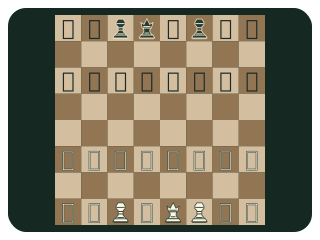
Ouk Chatrang is played by 2 players on a board with 8 × 8 squares. White moves first. Ouk Chatrang, the chess of Cambodia, adds special first moves for the king and neang to a Makruk-style army.
Ouk Chatrang is the traditional chess of Cambodia, a close relative of Thai Makruk played on an 8×8 board. Pawns start on the third rank and promote to met on the sixth. On their first move, the king may make a forward knight jump and the met may jump two squares straight ahead. Checkmate wins, and endgame counting can force a draw. This guide covers Ouk Chatrang. Check the movement, capture and game-ending rules below before applying rules from another variant.
Game illustration. Follow the setup instructions to prepare a new game.
The same 8×8 arrangement as Makruk: White's king on d1 and neang on e1, Black's neang on d8 and king on e8, koul on c1/f1 and c8/f8, and pawns on the third ranks. The king and neang keep their special first-move rights. White moves first.
Board
8 × 8 squares
Players
2
First move
White moves first.
Rules used here
Ouk Chatrang
02Moves and captures
Legal moves
King, rook and knight use chess moves. The koul steps one square diagonally or straight forward; the neang steps one square diagonally. Pawns move one square forward, capture diagonally and become a neang on their sixth rank.
Using the board
Select a piece to see its legal destinations, then select a highlighted square.
03Special rules
On its first move, if not in check, the king may jump like a knight onto the next rank, two files to either side (b2 or f2 for White, c7 or g7 for Black), without capturing.
It loses this right once it has moved or once an enemy rook moves to attack it.
On its first move, the neang may jump two squares straight ahead to an empty square.
There is no castling or pawn double step.
04Winning and draws
Checkmate wins.
Stalemate is a draw, and there is no 50-move rule.
Board count: as soon as a side has three pieces or fewer (king included), even with pawns on the board, its opponent must checkmate by count 64, counting from 1.
Bare-king count, once no unpromoted pawns remain and one side has only its king: counting starts from the number of pieces on the board plus one, and the attacker must mate by count 8 with two rooks, 16 with one rook, 22 with two koul, 32 with two knights, 44 with one koul, or 64 otherwise.
If the count runs out, the game is drawn.
A player may claim a draw on threefold repetition; a position where neither side can checkmate is drawn automatically.